Recover, Discover, Plan:
Learning Skills and Concepts from Robot Failures

ReSYNC turns a recovery learned from one failure into an abstract skill the robot can plan with anywhere.

One failure. A reusable idea.

From failure to foresight

Follow the four moments that turn a brittle robot into a planner that learns.

Deployment

Initial skills meet a hard corner.

The robot knows Pick and Insert. A block against the wall makes Pick fail.

Pick(block)Insert(block, block)×
Pick failed
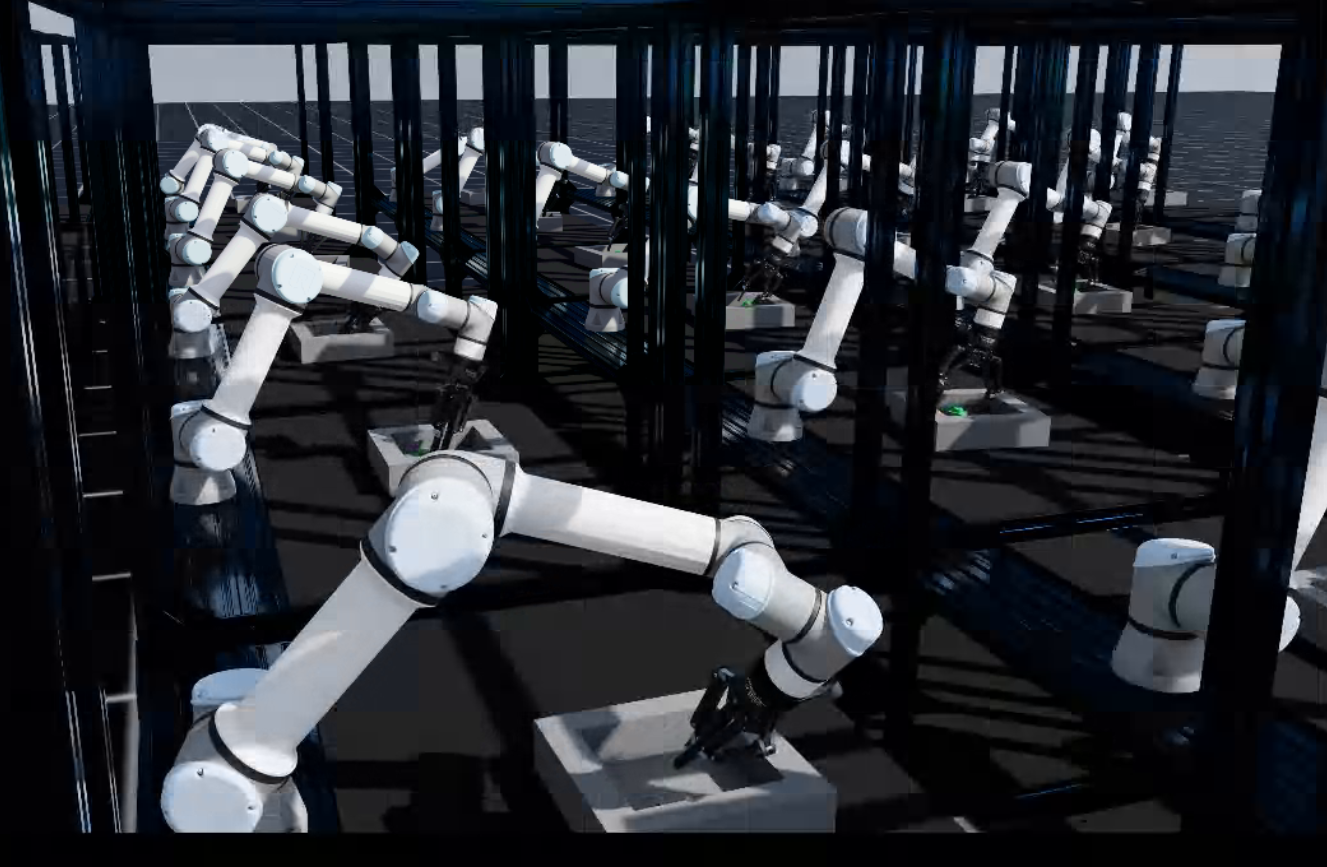
Reactive recovery

Why recovery alone is not enough

Too late is a different state.

A reactive policy waits for insertion to fail. By then another block is involved, the scene is out-of-distribution, and recovery cannot restore a solvable state.

Insert failsRecover lateOOD state
ReSYNC plans Poke first.
It reuses recovery while the state is still recoverable.

Empirical results

Generalization is the test.

Success rate across four simulated domains. Gray columns are held-out, compositionally novel tasks.

70%average success
on novel tasks
MethodIcy TransportCluttered Drawer
T₁ trainT₁ testT₂ trainT₂ testT₁T₁ trainT₁ testT₂ trainT₂ testT₁
GNN.98±.03.01±.01.18±.13.18±.13.38±.18.86±.04.00±.00.69±.07.48±.10.00±.00
TF.98±.03.00±.00.26±.14.17±.12.52±.16.11±.07.00±.00.03±.03.02±.02.00±.00
VLM-OS.39±.13.00±.00.30±.14.00±.00.24±.12.68±.06.29±.03.18±.04.25±.06.50±.10
DSG-S.67±.12.00±.00.24±.07.02±.02.44±.08.73±.03.04±.01.67±.04.04±.01.38±.02
DSG-M.61±.04.33±.04.15±.07.01±.02.21±.05.13±.02.03±.01.00±.00.00±.00.09±.04
RC.71±.11.00±.00.34±.16.00±.00.50±.18.68±.03.01±.01.62±.04.14±.02.35±.15
RC+IVNTR.50±.20.44±.18.18±.12.08±.08.66±.16.69±.03.59±.15.64±.03.27±.18.58±.14
ReSYNC.92±.05.76±.16.85±.09.68±.13.87±.09.95±.01.96±.02.64±.02.72±.03.76±.03
MethodBlocked StackingRearrange
T₁ trainT₁ testT₂ trainT₂ testT₁T₃ trainT₃ testT₁,₂T₁ trainT₁ test
GNN.74±.03.08±.06.55±.11.12±.10.00±.00.56±.15.07±.06.03±.02.39±.12.00±.00
TF.74±.03.05±.10.66±.05.11±.12.68±.02.72±.05.08±.06.35±.16.15±.14.00±.00
VLM-OS.74±.01.04±.03.19±.15.02±.01.21±.10.00±.00.09±.08.23±.14.26±.02.00±.00
DSG-S.66±.05.04±.03.52±.14.01±.02.35±.19.68±.04.00±.00.17±.07.35±.03.00±.00
DSG-M.38±.06.05±.03.01±.02.01±.01.07±.10.00±.00.05±.03.05±.02.18±.03.15±.00
RC.75±.03.04±.04.61±.11.24±.18.39±.17.10±.03.16±.12.17±.14.00±.00.00±.00
RC+IVNTR.74±.02.70±.03.64±.04.17±.13.72±.02.64±.04.37±.17.09±.10.47±.12.48±.12
ReSYNC.73±.04.76±.05.67±.10.84±.06.76±.02.69±.05.72±.08.80±.06.59±.03.57±.03

Table 1. Success rates in four simulated domains, averaged over five random seeds (± standard deviation), 50 tasks per scenario. ReSYNC is competitive in seen tasks and consistently strongest on unseen compositions while retaining earlier skills.

Acknowledgements

Built with generous support.

This work was supported by AFRL and DARPA (FA8750-23-2-1015), DSTA, the ACCESS program, and a Princeton SEAS Innovation grant. This work is also supported by the NVIDIA Academic Grant Program using NVIDIA RTX PRO 6000 GPUs. We thank Patrick Yin for support on the real-robot and sim-to-real experiments, and Jiayuan Mao for valuable early feedback.